
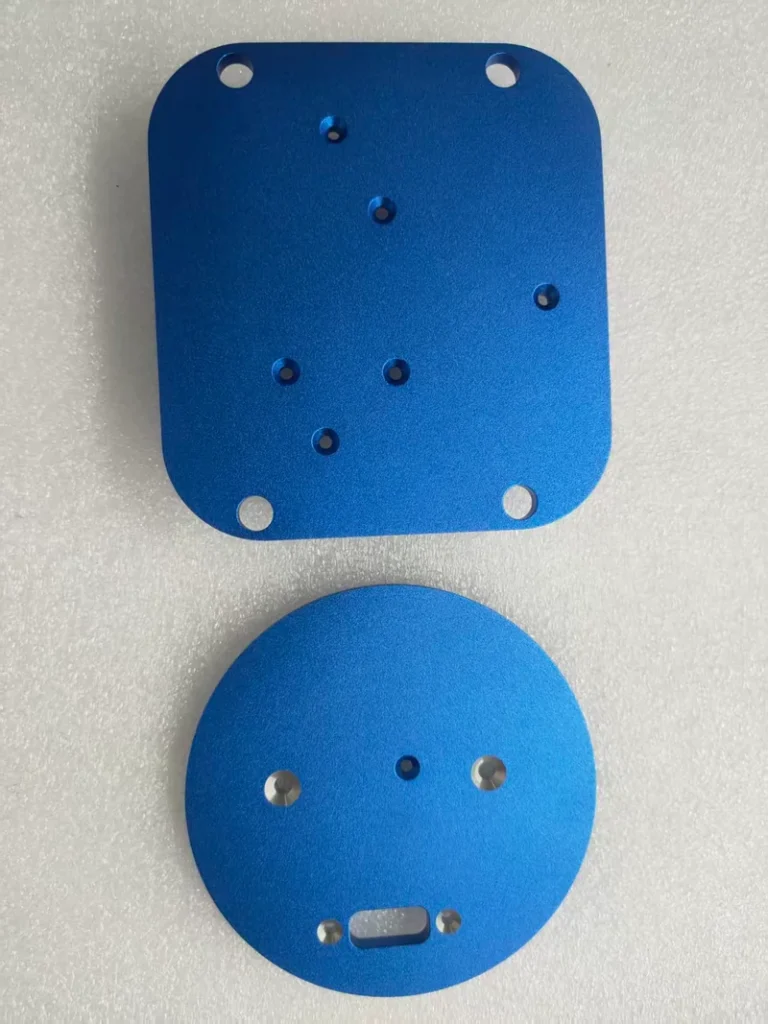
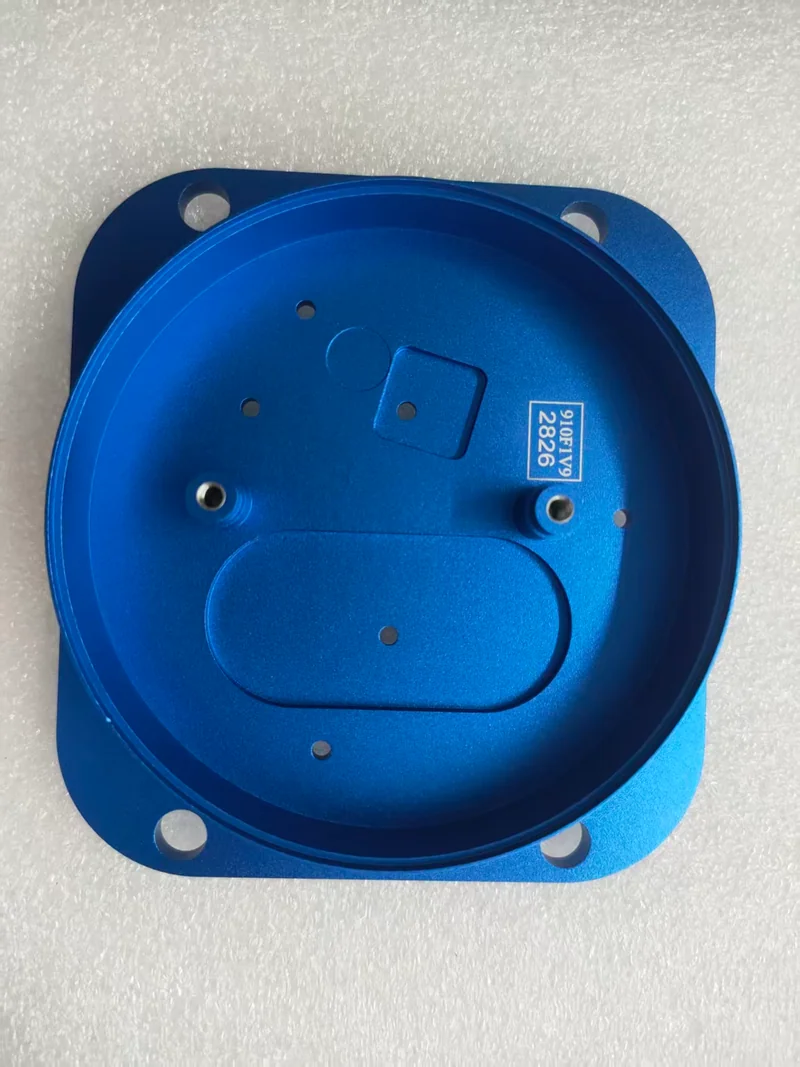
This project covers the base and cover of a miniature fiber optic gyro, machined from 6061 aluminum and finished with fine bead blasting plus sky-blue anodizing at a film thickness of 10–12 µm. The parts are used in autonomous, aerospace, marine and industrial applications, where both appearance and dimensional control are critical.
| Parts | Base and cover |
|---|---|
| Application | Miniature fiber optic gyros — autonomous, aerospace, marine and industrial use |
| Material | 6061 aluminum |
| Surface | Fine bead blast + sky-blue anodizing, film 10–12 µm |
| Tolerances | ±0.05 / ±0.06 mm on several dimensions · untoleranced IT12 |
| Thread | M3-6H |
| Marking | Laser marking at specified positions and content |
The Challenge
Selective oxide removal on the E face and threaded holes
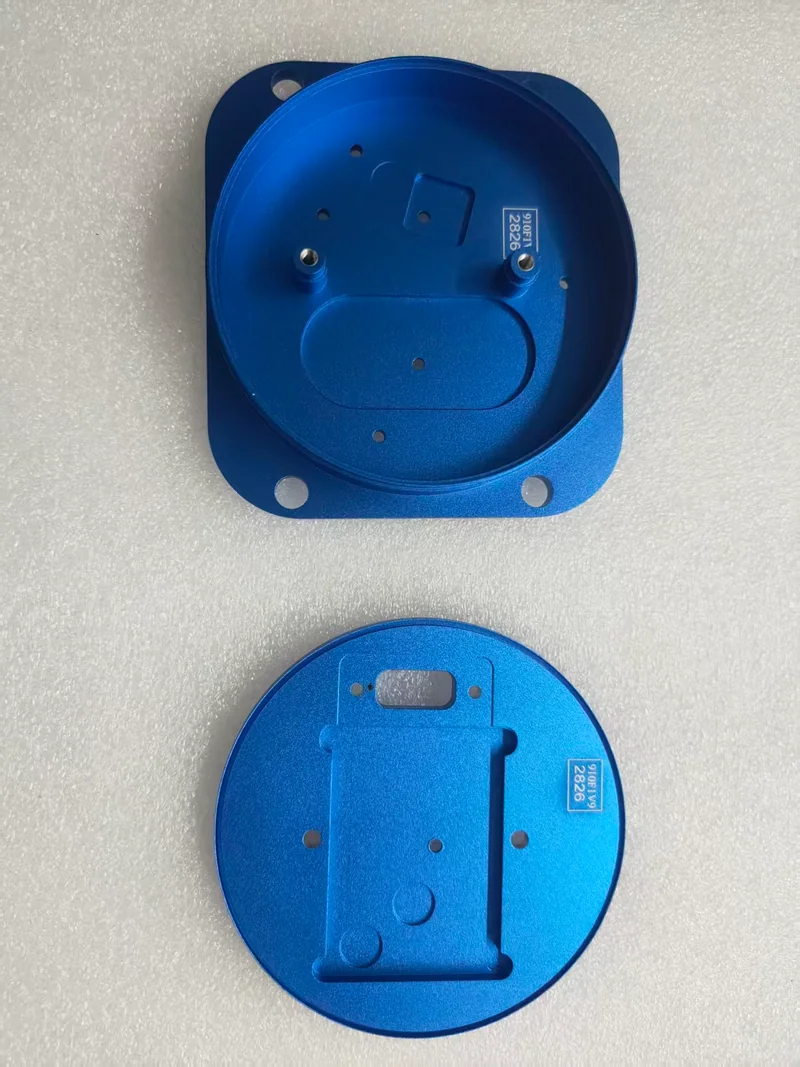
The part is anodized sky blue overall, but the E face and the T threaded holes must have the oxide layer removed to expose the base material. Masking under bead-blast conditions is difficult, and a second de-oxidation step can easily scratch the surrounding anodized surface.
Thread form protection
The threaded holes are M3-6H. When the oxide film is removed, the thread form must not be damaged.
Sharp edge control
No chamfers may be added on our own initiative. Sharp edges may only be lightly sanded with abrasive paper to remove burrs — a requirement that is difficult to control consistently in production.
Tight tolerances and deformation
Several dimensions carry tight tolerances of ±0.05 / ±0.06 mm, with untoleranced dimensions to IT12. The base cavity is prone to chatter, and the thin cover plate can warp due to internal material stress during machining.
Surface appearance and colour consistency
Fine bead blasting plus anodizing must be matched against the sample part, keeping colour difference under control while holding film thickness stable at 10–12 µm.
Laser marking
Marking must be applied at the specified position with the specified content, without damaging the surrounding anodized surface.
What the Project Requires
- •Masking protection for the E face and T threaded holes, so the oxide is removed selectively without touching the anodized areas.
- •De-oxidation carried out so that the M3-6H thread form is not damaged.
- •No added chamfers — sharp edges sanded only to remove burrs.
- •Machining controlled against chatter in the base cavity and warping of the thin cover plate.
- •Fine bead blast and anodizing matched to the sample, with film thickness kept at 10–12 µm.
- •Laser marking at the specified position without damaging the surrounding anodized surface.
Working on base and cover parts for fiber optic gyros? Send your drawing and surface requirements — our engineers review precision engineering and part design details, including selective anodizing and thread protection.