
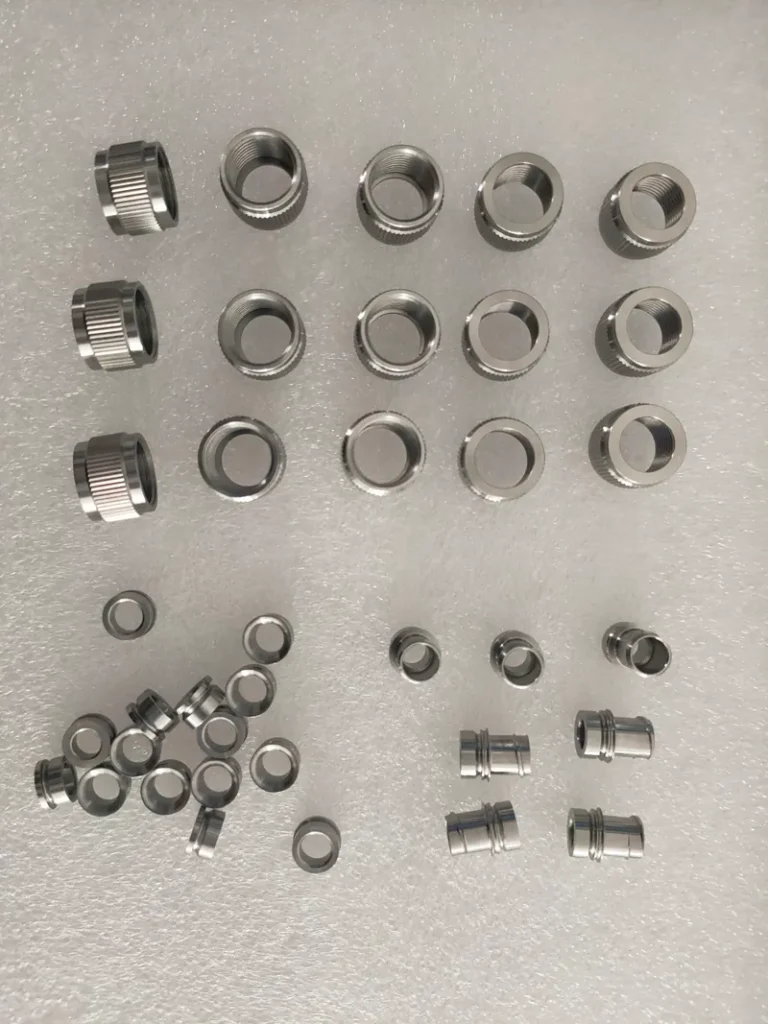
A sensor rotary connection set: a hex nut, a base swivel, a tee housing and a threaded plug, machined from AISI 303 free-cutting stainless and AISI 316L corrosion-resistant stainless. The parts share one thread-and-seal interface, so each one carries an edge rule that cannot be broken, and they are produced 50 pieces per part.
| Parts | Hex nut · base swivel · tee housing · threaded plug |
|---|---|
| Materials | AISI 303 free-cutting stainless · AISI 316L austenitic stainless |
| Threads | M24×2 on the hex nut, 30° chamfer to thread root · fine external thread on the plug |
| Bores | Φ22.30 ±0.10 bored after tapping · Φ22.10 ±0.05 · Φ21.30 ±0.05 · Φ20.30 H10 |
| Geometry | Flatness 0.01 · parallelism 0.1 · perpendicularity 0.05 |
| Seal faces | Ra 0.4 · weld edges R0.05 max · R0.4 max elsewhere |
| Edges | C0.05–0.1 on all sharp edges, no over-break |
| Tolerances | ISO 2768-Fm on untoleranced dimensions |
The Challenge
Two stainless grades in one batch
AISI 303 machines freely because of its sulphur addition, but that same sulphur shows up as pinholes and inclusions on a high-gloss face. AISI 316L is the opposite: it galls, work-hardens and resists a clean finish. Running both grades in the same batch means separate tooling, separate programs and separate handling: mixing them is a scrap event, not a scheduling inconvenience.
Bore after thread, never the other way round
The hex nut is tapped M24×2, then its Φ22.30 ±0.10 bore is precision-bored. The drawing fixes that order. Boring after tapping is delicate: the boring bar can drag the thread crest, cutting stress can distort the pitch, and the interruption where the bore meets the thread root pulls the tool. The setup has to hold the part without loading the threaded section.
A 30° chamfer that runs into the thread root
The thread entry carries a 30° chamfer to the root of the first thread, with a 75° thread-root profile and two R0.5 max fillets. The chamfer has to start, angle and stop precisely: too deep and it cuts away the effective thread, too shallow and it scrapes the mating seal on assembly. The two R0.5 fillets control how smoothly the nut threads on, so they cannot be blended by hand.
R0.05 here, R0.4 there
The base swivel has two different radius rules on the same part: R0.05 max at the weld preparation face and R0.4 max at a second feature. Confusing them is easy and expensive. The weld radius may not be polished or touched with a linishing belt, because any growth there changes the weld groove and the gas seal it has to make.
A cross hole with a burr inside it
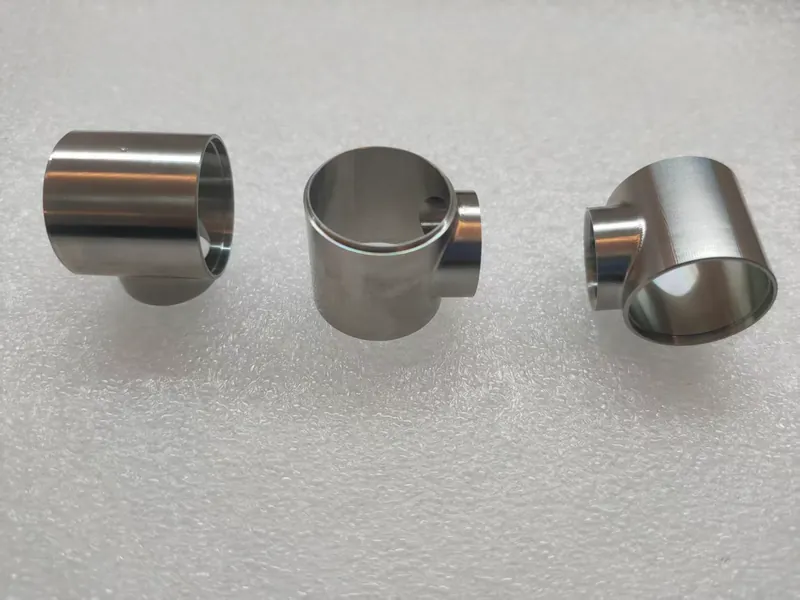
The tee housing is a thin-wall cylinder with a branch that intersects the main bore. The burr forms on the inside of the intersection, where it is invisible from outside and awkward to reach. Deburring too little leaves a fragment that can break free in service; deburring too much eats into the bore wall and changes the internal diameter.
Ra 0.4 faces on 316L
The seal faces are turned to Ra 0.4 with no tool marks, chatter or feed lines. On 316L that depends on spindle runout, insert condition, feed rate and coolant reaching the cut. A single worn insert or a slightly loose setup prints a ring on the face that the seal will not forgive.
A 0.3 mm centre hole that must be clean
The base swivel carries a DIN 333A centre hole, 0.3 mm deep, with no burr and no dent at the tip. The feature is small, its position is critical and it is difficult to measure, which is exactly why it becomes a customer inspection point.
Our Approach
- •Grade-segregated production: separate tooling, programs, trays and identification for 303 and 316L, so the two materials never share a setup.
- •Low-stress clamping for the nut, with the threaded section supported rather than gripped, so boring after tapping does not disturb the thread.
- •Chamfer and root profile cut with form tooling in the same operation as the thread, keeping the 30° entry and 75° root consistent from part to part.
- •Two radius rules tracked separately: R0.05 at the weld face is machined and left alone; R0.4 is controlled where the drawing allows it.
- •Cross-hole deburring from inside the bore with a controlled tool, proven on a first article, so the intersection is clean and the wall dimension is untouched.
- •Finishing passes planned for Ra 0.4: fresh inserts, stable spindle, controlled feed and coolant directed at the cut, with the face inspected under light before the part leaves the cell.
- •First-article approval and full gauging: thread go/no-go, radius gauges, height gauge and roughness checks on the critical features, with material certificates for the 316L components.
The Result
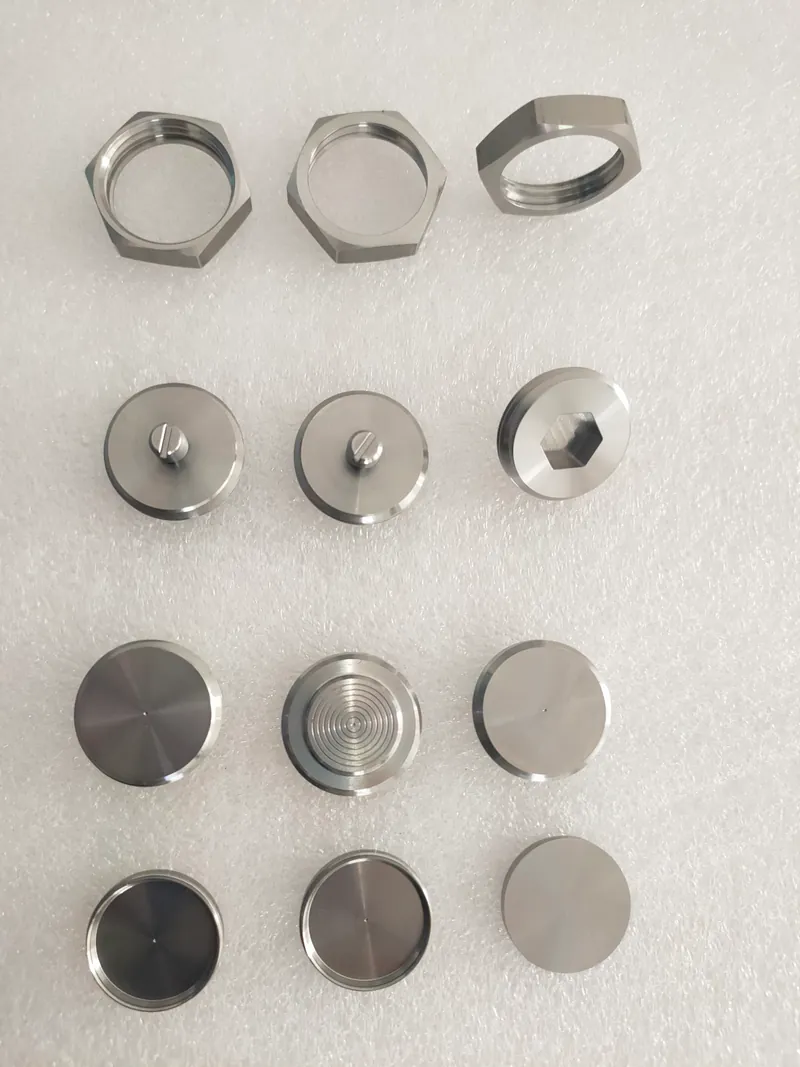
The set shipped as a matched assembly: nuts bored after tapping with their thread forms intact, Ra 0.4 seal faces without tool marks, weld edges at R0.05 max and the second radius held at R0.4 max. Gauging covered the threads, radii, height and roughness on the critical features, and the 316L parts carried their material certificates.
Threaded and sealed stainless assembly? Send the drawing set and the mating parts. We will review the thread-to-bore sequence, the seal-face finish and the deburring method before quoting, because those are where the cost sits.