
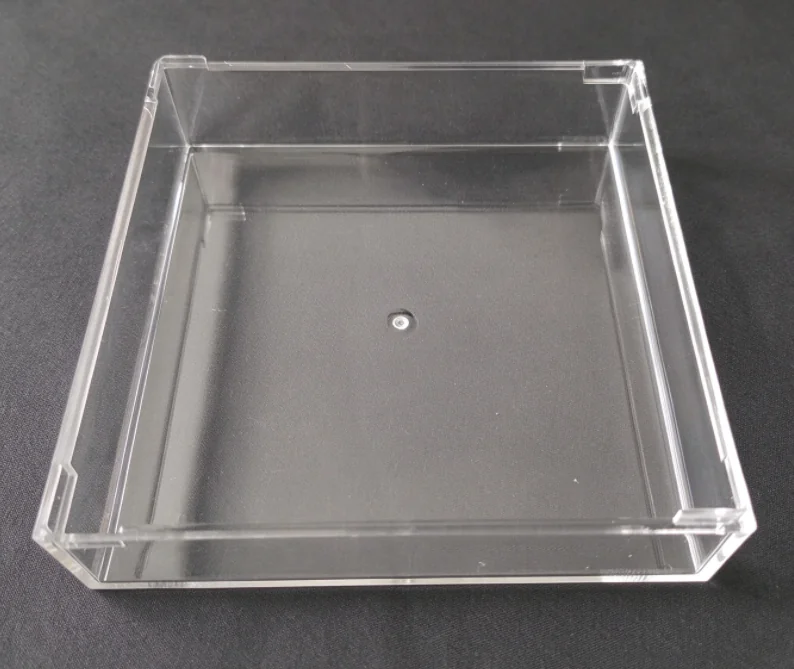
A transparent PMMA acrylic box produced by injection molding, with a surface requirement of Rz40 and untoleranced dimensions to H13/h13, ±IT13/2. For a clear part, the difficulty is not only dimensional — the appearance of the material itself has to be right.
| Part | Transparent square box |
|---|---|
| Material | PMMA (acrylic) |
| Process | Injection molding |
| Surface | Rz40 |
| Dimensions | Outer 97 mm · inner cavity 95 mm, with tolerances |
| Untoleranced dimensions | H13/h13 · ±IT13/2 |
| Corner radius | R1 at the four corners · 1° draft snap-fit lip |
The Challenge
Appearance control on a transparent part
PMMA injection molding is highly prone to silver streaks, bubbles, sink marks, weld lines, white haze and flow marks. The finished box must have high light transmission with no white haze, and both the inner and outer surfaces must be free of scratches and surface defects.
Thin wall plus shaped snap-fit structure
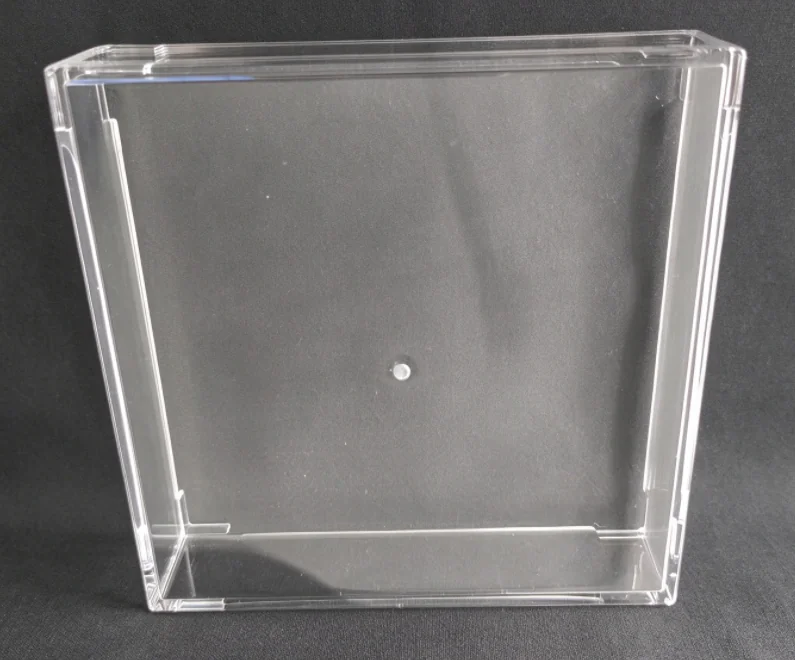
The side walls are thin, the four corners are R1, and the edges carry a snap-fit lip with a 1° draft. Thin walls are difficult to fill, so short shots and trapped-gas burning are a real risk. The position and dimensions of the snap-fit directly affect assembly fit, and during ejection the snap-fit can be dragged, whitened or even broken.
Dimensional and geometric accuracy
Features such as the 97 mm outer size and 95 mm inner cavity carry plus/minus tolerances. Because PMMA shrinkage fluctuates, a square cavity easily ends up with non-perpendicular sides or a warped shape — which shows up as poor seam fit.
Sharp corners and R corners
The four corners use a small internal radius of R1. At such a small corner the melt meets high flow resistance and filling can be incomplete. PMMA is also brittle, so stress concentration at the corners during ejection leads to chipping and cracking.
Internal stress
During cooling, PMMA easily retains internal stress. Stress cracking can appear later at the points where that stress is concentrated.
What the Project Requires
- •Control of material drying, mould temperature and injection speed to keep the box clear inside and out, without scratches or surface defects.
- •Fill behaviour managed on the thin walls and small R1 corners, where flow resistance is highest.
- •Snap-fit feature handled so the lip is not dragged, whitened or broken during ejection.
- •Shrinkage variation taken into account so the square cavity stays square and unwarped, and the seams fit.
- •Stress-relief annealing after molding, together with controlled holding pressure and cooling parameters to reduce residual stress.
Need a clear PMMA or transparent enclosure? Send your drawing and appearance requirements — our team reviews plastic molding and injection molding details, from fill behaviour to stress-relief annealing.